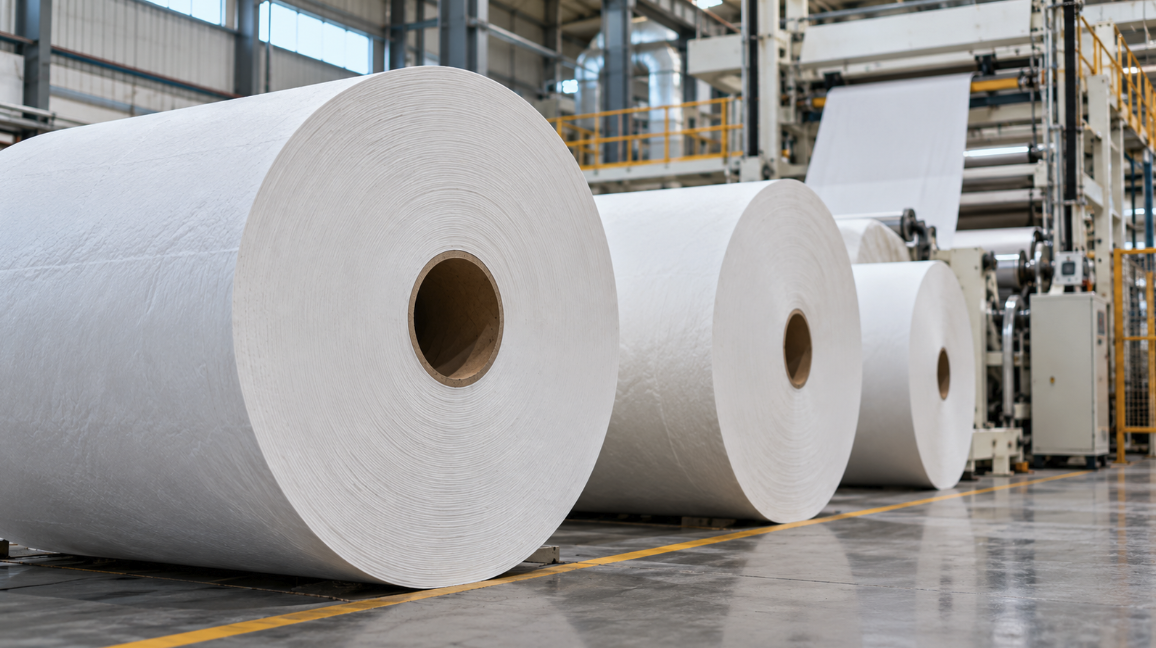
A tissue parent roll is a large reel of base tissue paper used to manufacture finished products such as toilet rolls, facial tissues, paper towels, and napkins. Converters unwind the paper and process it into the required size, format, and packaging.
Buying a parent roll means buying material for further production. The paper must meet the needs of the finished product and work with the converter’s equipment.
This guide explains how parent rolls are used, how they differ from finished tissue, and what to confirm before ordering.
What Is a Tissue Parent Roll?
A tissue parent roll holds a continuous length of tissue paper for further processing. It sits between tissue manufacturing and finished-product production.
Suppliers may use terms such as tissue mother roll, parent reel, or tissue jumbo roll. Terminology can vary, so confirm the supplied roll’s format and specifications rather than relying on the name alone.
The mother reel coming from a tissue machine may need rewinding, slitting, or combining before further converting. The steps depend on the equipment and the finished product. Valmet describes these operations as part of the journey from the tissue machine to consumer products.
JX Papers supplies tissue paper jumbo rolls in virgin and recycled grades for converting applications.
How Are Tissue Parent Rolls Different From Finished Tissue Products?
Parent rolls are production inputs. Finished tissue products have been converted into a format ready for their intended use, such as a household toilet roll or a pack of folded hand towels.
| Factor | Tissue Parent Roll | Finished Tissue Product |
| Purpose | Material for further processing | Ready for its intended application |
| Format | Large reel of continuous tissue paper | Individual rolls, folded sheets, or packaged products |
| Typical buyer | Converter or manufacturer | Distributor, retailer, facility buyer, or consumer |
| Further work | Requires suitable converting equipment | Generally ready for distribution or use |
| Key purchasing details | Paper grade, reel dimensions, core, weight, and converting performance | Sheet size, roll length, ply, packaging, and dispenser compatibility |
A jumbo toilet roll for a commercial washroom is not necessarily a parent roll. It may already be a finished product designed for a dispenser.
When requesting a tissue jumbo roll, state clearly whether you need base tissue for converting or a finished commercial roll.
What Products Can Be Converted From Tissue Parent Rolls?
Suitable tissue parent rolls can be converted into toilet tissue, kitchen towels, hand towels, facial tissue, and napkins. Valmet identifies these among the products made through tissue converting.
However, one paper grade should not be assumed suitable for every application.
| Finished Product | What Converters Should Evaluate |
| Toilet tissue | Softness, strength during use, breakdown performance, and roll format |
| Facial tissue | Hand feel, lint, strength, and folding performance |
| Kitchen towels | Water absorption, wet strength, and roll construction |
| Hand towels | Absorbency, wet strength, folding or winding, and dispensing |
| Napkins | Feel, folding, appearance, and printing or embossing requirements |
Start with the finished product specification. A converter making folded towels may need a different grade and reel configuration from one producing facial tissues.
How Are Tissue Parent Rolls Converted?
Converting changes base tissue into the required product format. Operations can include unwinding, combining layers, embossing, perforating, rewinding, cutting, folding, and packaging. The sequence depends on the production line and product.
Rolled Products
For toilet rolls and kitchen towels, the line may combine layers, emboss the paper, add perforations, and rewind it. The wound product is then cut and packaged according to the required format.
Folded Products
For facial tissues, napkins, and folded hand towels, the process may include cutting, folding or interfolding, stacking, and packaging.
Not every product requires every operation. Confirm the paper’s suitability for the actual processes used on your line.
The condition of the reel also matters. Valmet’s winding guidance emphasizes preserving sheet properties while producing reels that unwind and handle well.
What Specifications Do Converters Need When Buying Parent Reels?
Converters should confirm the paper grade, GSM, supplied ply configuration, reel width, outside diameter, core dimensions, and reel weight. Performance requirements, winding quality, packaging, and traceability should also be agreed before ordering.
Use the following checklist when preparing a purchase specification.
| Specification | What to Confirm |
| Intended application | The finished product the paper will be used to make |
| Fiber composition | Virgin, recycled, or a specified composition |
| GSM or basis weight | Target grammage, acceptable variation, and measurement basis |
| Supplied ply configuration | Whether layers are supplied separately or combined |
| Reel width | Required width and permitted variation |
| Outside diameter | Maximum diameter accepted by the equipment |
| Core dimensions | Internal diameter, length, and other equipment requirements |
| Reel weight | Maximum weight permitted for unwinding and handling |
| Paper performance | Relevant strength, softness, absorbency, and lint requirements |
| Winding and splices | Agreed winding condition and splice identification |
| Packaging and identification | Protective wrapping, reel labels, grade, and batch details |
GSM and Ply
GSM means grams per square meter. Ply describes the number of layers.
Confirm whether the quoted GSM applies to each layer or to the combined supplied paper. Also clarify how the supplied configuration relates to the finished product you intend to make.
A request for a “2-ply product” does not, by itself, tell the supplier how your converting line needs the parent reels supplied.
Reel Dimensions and Weight
Check the limits of your unwinder and handling equipment before agreeing on reel dimensions.
A reel can meet your paper requirements while exceeding the equipment’s diameter, width, core, or weight limits. Give the supplier the relevant machine specifications rather than asking for a standard size.
Paper Performance
Request measurements relevant to the intended product. These may include dry strength, wet strength, absorbency, thickness, and softness.
Compare results using consistent test methods and conditions. Matching GSM alone does not establish equivalent performance.
For recycled grades, JX Papers’ research on recycled OCC pulp and tissue applications provides additional context on pulp processing and tissue properties.
Winding Quality and Splices
Ask how splices, where paper lengths are joined, are identified. Agree on acceptable reel condition and how any defects will be documented.
During a trial, record unwinding problems and web breaks. This gives both parties specific information to investigate rather than a general report that the paper “does not run well.”
Can Tissue Parent Rolls Be Made From Recycled Pulp?
Yes. Tissue parent rolls can be produced using recycled fibers as well as virgin pulp.
JX Papers lists virgin pulp jumbo rolls and 100% recycled tissue jumbo rolls, including white and natural brown recycled options.
Specify the fiber composition and appearance you need. If recycled content or certification is part of your purchasing requirements, request documentation for the selected grade.
Then assess the paper against the same finished-product and production requirements used for other options.
What Should You Check Before a Bulk Order?
A sample review and production trial answer different questions. A small sample helps assess the paper, while a trial reel helps establish how it behaves on your equipment.
1. Share the Finished Product Requirements
Provide the intended application, dimensions, ply, expected performance, and any reference sample.
2. Confirm Equipment Compatibility
Check reel width, diameter, core dimensions, weight, and supplied layer configuration with your production team.
3. Review Samples and Specifications
Compare the proposed grade with the reference product. Record differences in feel, appearance, and relevant test results.
4. Run an Agreed Trial
Assess the paper on the intended line. Record operating conditions, web breaks, dust, waste, and finished-product quality.
5. Approve a Written Specification
Keep the agreed specifications, tolerances, sample, and trial findings together. Use them as the reference for production orders and future deliveries.
Frequently Asked Questions
Is a Tissue Mother Roll the Same as a Parent Roll?
The terms are often used for large tissue reels intended for further processing. However, suppliers may distinguish between the original machine reel and reels prepared for converting. Confirm the exact format being supplied.
Can One Parent Roll Grade Make Every Tissue Product?
Do not assume so. Toilet tissue, facial tissue, towels, and napkins have different requirements. Select and test the grade for its intended application.
What Is the Standard Size of a Tissue Parent Roll?
There is no single size that fits every converting line. Required width, diameter, core dimensions, and weight depend on the equipment and production plan. Confirm these before requesting a quote.
Should I Buy Parent Rolls or Finished Tissue Products?
Buy parent rolls when you have suitable converting capacity or a converting partner. Buy finished tissue when you need products ready for distribution, retail, or facility use.
What Should a Parent Roll Quote Request Include?
Include the intended product, fiber composition, GSM, supplied ply configuration, reel dimensions, core requirements, maximum reel weight, quantity, and delivery destination. Add performance requirements and trial needs where available.
Discuss Your Parent Roll Requirements With JX Papers
JX Papers supplies virgin and recycled tissue parent rolls for converting applications.
Share the product you plan to make, your paper requirements, and the reel sizes your equipment accepts. Include an estimated order quantity and reference sample where available.
Contact the JX Papers sales team to discuss suitable grades and trial requirements.