Introduction
In this blog, a new and quick testing method for evaluating commercial old corrugated cardboard/ containers (OCC) pulp was developed and used by a large Chinese boxboard manufacturer for quality control of imported OCC pulp.
In 2021, the comprehensive ban on the import of wastepaper was officially implemented in China, and China’s imported wastepaper and paperboard was reduced from 30 million tons/year in 2012 to zero in 2021. Some papermaking enterprises have faced the situation of intermittent fiber shortages in the last two years. In the face of the dramatic changes in wastepaper policies, many large packaging paper producers in China have begun to invest in recycled old corrugated cardboard/containers (OCC) pulp mills abroad to seek solutions to the shortage of raw materials. In the past two years, China’s recycled pulp imports have also been increasing, with 3.27 million tons imported in 2021 — mostly recycled OCC pulp imported from Southeast Asia [1]. The quality of imported OCC recycled pulp from Southeast Asia also varies when compared with OCC imported from North America, which is known as AOCC (American old corrugated cardboard/ containers).

In order to avoid the influx of low-quality recycled OCC pulp into Chinese market, it is important to establish a quick testing method for this new pulp stream and to guide Chinese packaging manufacturers to better use imported OCC pulp. In this paper, a quick testing method using fiber length was developed and compared with a traditional pulp testing method to evaluate the quality of imported OCC recycled pulps. This new testing method was internally applied at a large Chinese packaging manufacturer.
Experimental Design, Materials and Methods
Pulp samples
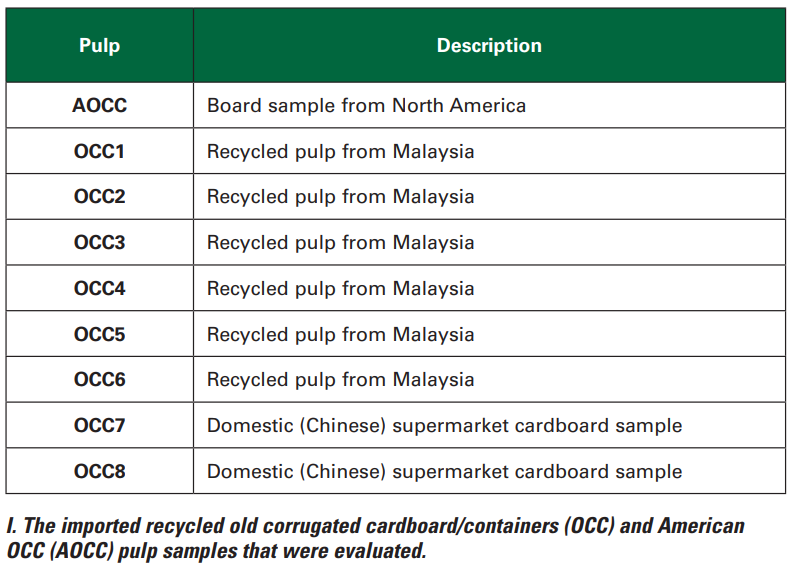
Imported recycled OCC and AOCC pulp samples and domestic recycled cardboard pulp were obtained from the raw materials purchase department of Zhejiang Jingxing Paper Co. Ltd., a large packaging board company in China. In this study, nine samples were evaluated, as described in Table I.
Fiber morphology analysis
The pulp sample was disintegrated according to ISO 5263 “Pulps — Laboratory wet disintegration.” Diluted suspensions of 20 mg/L were tested using a MorFi fiber analyzer (Technidyne/Industrial Physics; Boston, MA, USA).
Pulp properties analysis
Traditional pulp evaluation includes laboratory beating of pulp using a Valley mill according to TAPPI Standard Test Method T 200 “Laboratory beating of pulp (Valley beater method)” to a Canadian Standard Freeness (CSF) of 300 mL as measured by TAPPI T 230 “Laboratory beating of pulp (Valley beater method). TAPPI T 205 “Forming handsheets for physical tests of pulp” was used to create handsheets that, in this study, were 100 g/m2 handsheets.
Results and Discussion
TAPPI Standard Test Methods included in this study were:
- TAPPI T 807 “Bursting strength”
- TAPPI T 494 “Tensile properties of paper and paperboard (using constant rate of elongation apparatus)”
- TAPPI T 275 “Screening of pulp (Somerville-type equipment)”
- TAPPI T 211 “Ash in wood, pulp, paper and paperboard: combustion at 525°C”
Fiber morphology analysis
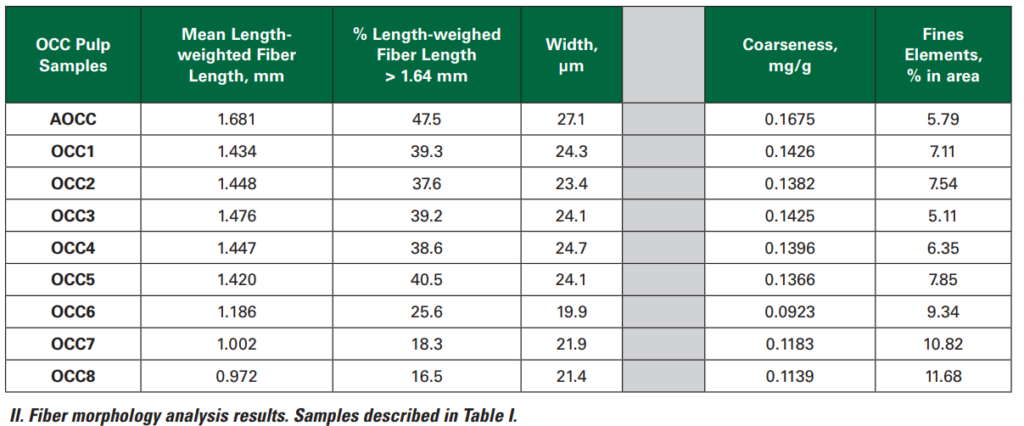
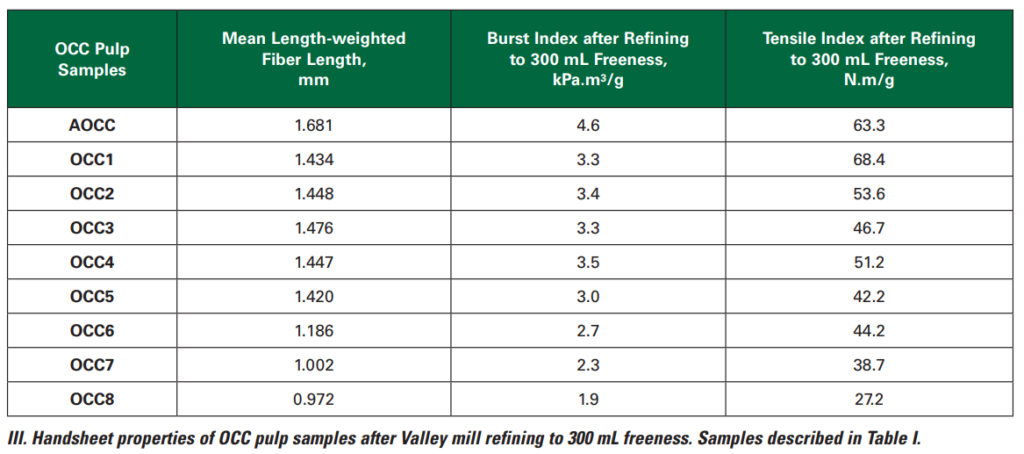
Fiber morphology analysis results are presented in Table II. As shown in Table II, AOCC fiber was the longest at 1.681 mm. Fiber lengths of OCC1–OCC5 ranged from 1.42 to 1.47 mm. However, the fiber length of OCC6 sample was only 1.186 mm. Fiber lengths of the two domestic supermarket cardboard fibers were 1.002 and 0.972 mm, respectively.
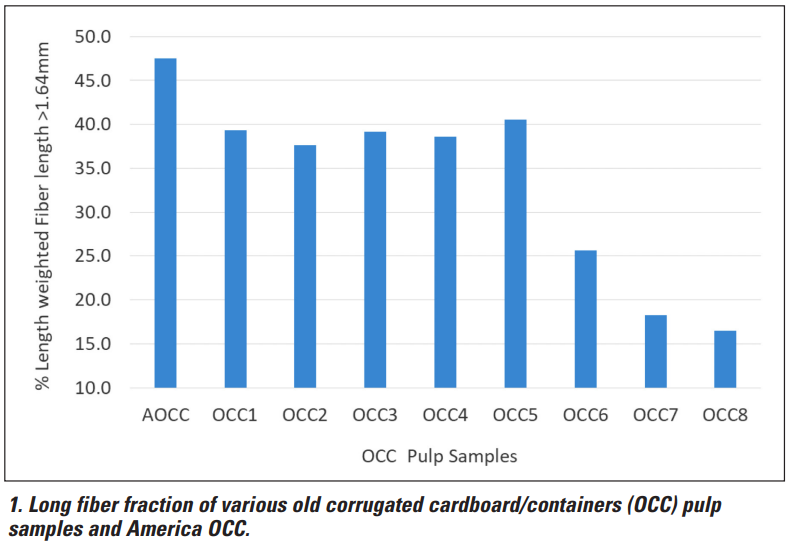
Long fiber fraction is a very important factor for evaluating OCC pulp samples. Figure 1 shows the percentage of long fiber (length-weighted fiber length greater than 1.64 mm). The AOCC was highest at 47.5%, followed by OCC1–OCC5 samples averaging 39.0%. The OCC6 sample was only 25.6%. The OCC-7 and OCC-8 domestic supermarket cardboard samples were the lowest at 18.3% and 16.5%, respectively.
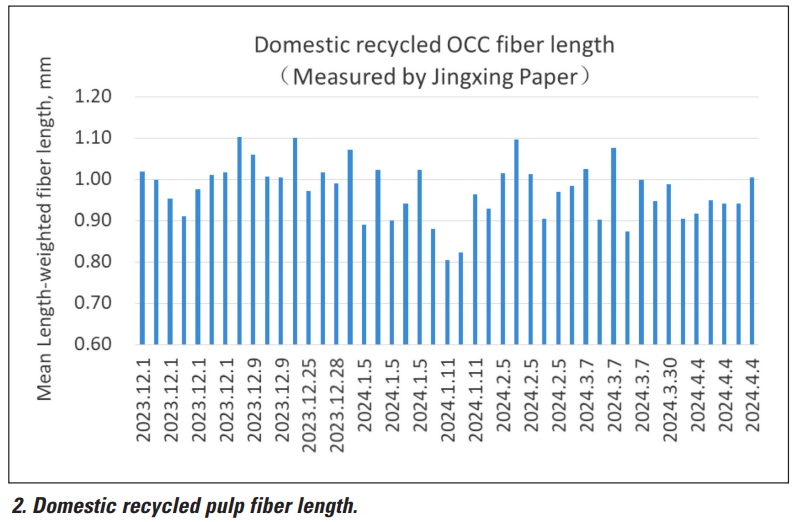
In China, containerboard and corrugated base paper production accounts for around 45% of the total amount of paper and cardboard, and the proportion using recycled board is increasing [2]. Figure 2 shows that the domestic recycled fiber length is getting shorter and shorter (measured by Zhejiang Jingxing Paper). To avoid the influx of low-quality recycled pulp into the Chinese market, it is important to know the long fiber faction of OCC pulp.
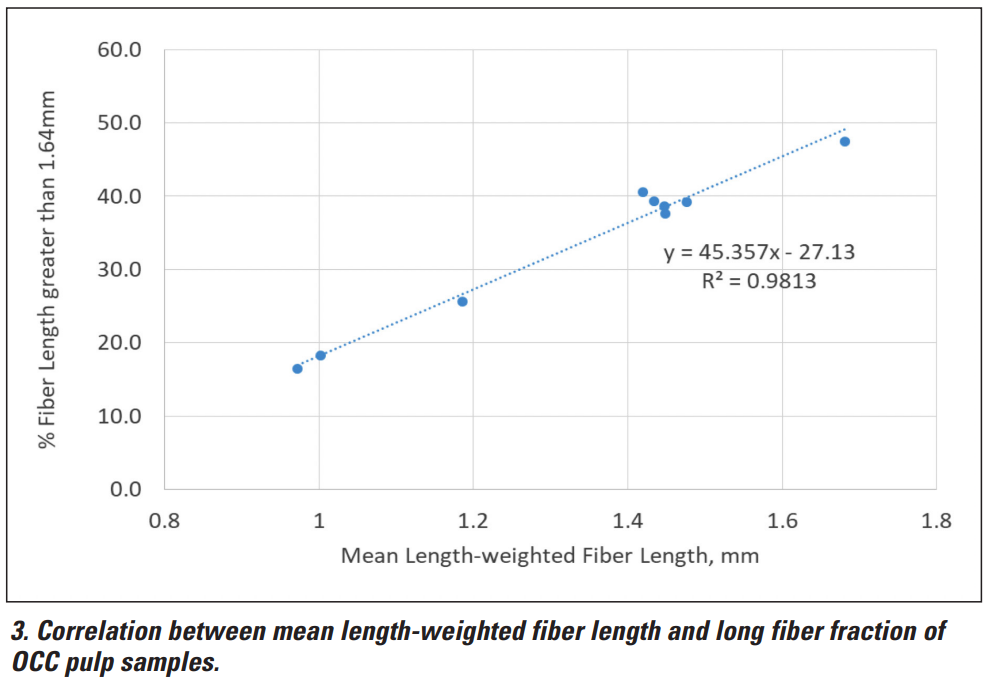
Figure 3 shows the correlation between mean length-weighted fiber length and percentage of fiber length greater than 1.64 mm; it has an almost linear relationship. This indicates that the mean length-weighted fiber length is a very good indicator to determine the fraction of long fiber in the recycled pulp.
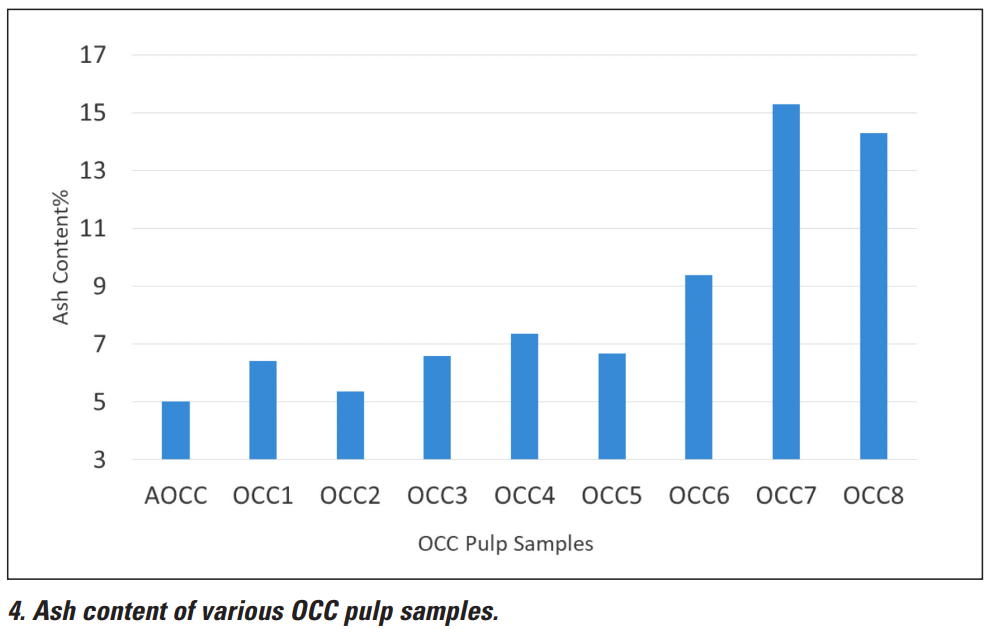
Ash content is another important indicator for evaluation of OCC pulp. Figure 4 shows the ash content of the various OCC pulp samples. The ash content of the AOCC and OCC1–OCC5 samples was less than 7%. The ash content of the OCC-7 and OCC-8 domestic supermarket cardboard samples content were higher than 13%.
The fines elements (% in area) shown in Table II also indicate that AOCC has the lowest value compared with the lower grade OCC pulp samples. It is another good indicator for evaluating OCC pulp samples.
Handsheet evaluation results
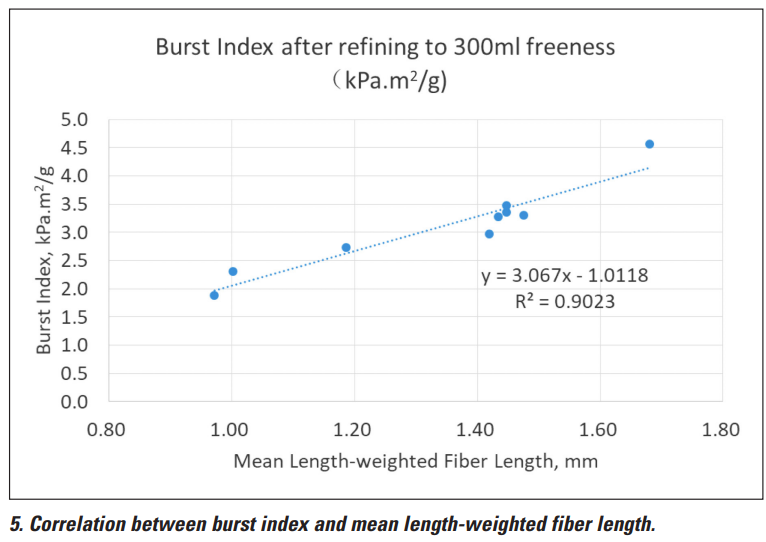
Traditional pulp evaluation includes laboratory beating of a pulp sample using a Valley mill to a CSF of 300 mL. Handsheet evaluation results at basis weight 100 g/m2 are presented in Table III. We have found a strong correlation between burst index and mean length-weighted fiber length, as shown in Figure 5. Burst index is one of the most important physical properties for making boxboard. Instead of beating pulp, forming handsheets, and analyzing physical properties, it is possible to use fiber length to evaluate OCC pulp.
New testing method used at Jingxing Paper Co. Ltd.
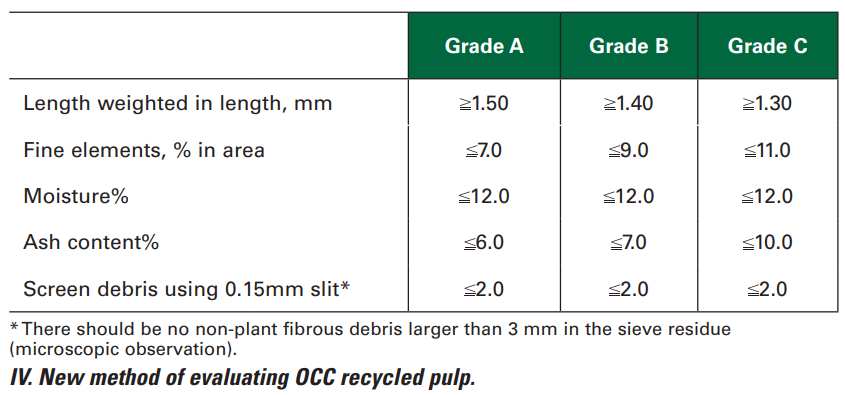
Table IV presents the new method for evaluating OCC pulp samples that was developed and is currently used to evaluate imported OCC pulp at Zhejiang Jingxing Paper Co. Ltd. The company has adopted this method as the mill’s internal standard for evaluating imported OCC pulp.
About the Authors
We studied this topic to find a better way of controlling the quality of incoming old corrugated cardboard/containers (OCC) recycled pulps at our company. Unlike traditional methods, our proposed method of evaluating pulp samples primarily uses fiber analysis, which is quicker and better.
The most difficult part of this research was to quantify impurities. To do so, we used Somerville-type equipment.
By evaluating a large number of test results, we found out that OCC fiber length is directly related to strength properties. It was interesting to see how quality changed with time, especially for Chinese domestic recycled board, with fiber getting shorter and shorter.
Our mill has used the proposed new method as the internal testing standard for incoming OCC pulp since September 2023. We have released two lab technicians from routing testing to research-type positions. We are following testing results closely, and if the new method is used with no problems, we will apply for a new Chinese national testing standard for OCC recycled pulp.

Sun is vice president, Lv is senior engineer, Zhou is research engineer, and Chen is president at Enterprise Research Institute, Zhejiang JingXing Paper Joint Stock Co. Ltd., in Pinghu City, Zhejiang, China. Email Sun at sun.yanping@jxpaper.com.cn.
Conclusion
In this paper, nine OCC samples were evaluated using fiber morphology analysis and then compared with a traditional method for evaluating pulp handsheets. A new testing method using fiber morphology was developed to quickly evaluate imported OCC pulp. This method has been successfully adopted by a large Chinese boxboard manufacturer as a mill internal standard.
Literature Cited
- Xu, W., “Review and outlook of China’s recycled fiber market,” China Pulp Pap. Ind. 41(1): 35(2020)
- Anon., “China Pulp and Paper Industry: Annual Report 2022,” China Pulp Pap. Ind. 44(11/12): 21(2023)
About this Paper
Cite this article as:
Sun, Y.P., Lv, X.F., Zhou, P.Y., et al., TAPPI J. 23(7): 395(2024). https://doi.org/10.32964/TJ23.7.395
DOI: https://doi.org/10.32964/TJ23.7.395
ISSN: 0734-1415
Publisher: TAPPI Press
Copyright: ©TAPPI Press 2024